

Point One: Contact in a Context
Part 2 of 2

Summary
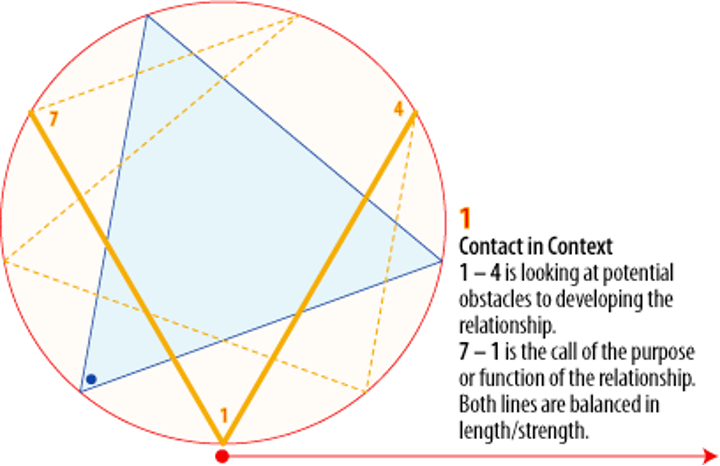
Point 1 is the premise, the necessary condition for the formation of loving relationships. Pair bonds are not formed from nothing, but emerge out of the social fabric, from the random casual contact of “social atoms” — individuals. The events that make up this prerequisite set of circumstances include flirting, gossip and exploratory dates — the lunch, the cup of coffee, the first date, the blind date. At point 1 we actively look at the similarities and differences between our own background and those of the possible mates we encounter (1 – 4). Our vision is colored or shaped by the potential for true partnership (7 – 1). We can also look for a congruence in life goals (1 – 7), and for similar ways of “being family” (4 – 1).
In the social domain, the scanning that occurs at point 1 can be totally focused on externals: what kind of house do I want to live in, in what neighborhood, what kind of car do I want to drive wearing what label clothes, which resort destinations do I want to visit? A man or woman making this kind of assessment will be looking mainly for an economic partner. This is an important and necessary aspect of a committed relationship, especially so today when both partners are required to contribute, as earners, savers and providers of free labor to the economic viability of the family. The point 4 issues (possible points of conflict) will be mainly external: what kind of education does this person have, how much money may be available from their family of origin, what are the possible career paths for this person and what is the likelihood of success on those paths?
In the personal domain, we focus on internals: what kind of person do I want to become? What are the character traits I would like to cultivate, which would I like to weaken? What level of freedom of will do I want to reach? How much inner peace and unconditional joy do I want? Is my prospective partner aiming in the same direction and with the same degree of intensity? What obstacles will they need to overcome on the way?
This kind of analysis is rare in young people, but for those of use who are contemplating a new relationship in middle or later life, it may be possible. In fact, it may be necessary: the number of people who are happy simply because they’ve achieved a defined lifestyle is quite small. What the “chef” in us demands has to do the quality of experience, not the content. A valid premise for a relationship must include the quality of life as well as content of life’s time.
Somewhere in between are the feelings that turn facts into experience for us. A relationship premise may include how we want to feel as well as how we want to live, and, in the transpersonal domain, how free we wish the quality of our experience to be from the content of that experience.
Whether you know it and acknowledge it or not, all these dimensions of being human will be part of your relationship, your growth through that relationship and your satisfaction with that relationship. At point 1 you can evaluate your potential partnership in terms of the physical basis of life (the social dimension), the direction(s) in which you want to grow (the personal dimension) and the degree of inner freedom to which you aspire (the transpersonal dimension). You can also have an eye out for the differences between yourself and your potential partner along these three dimensions.
Authenticity
Because we spend so much of our time “in the kitchen,” that is in social (as opposed to personal or intimate) interaction, it’s easy to confuse the different aspects of being human. It takes a long time to make the distinction between the social reflection we get from other people and the person we are. The social mirror is important: it is a necessary aspect of who I am and how I live. It limits, expands and directs my possibilities as a member of a society and a culture. At the same time, the social mirror is a funhouse mirror. The reflected image of myself that I receive from other people is distorted by their prejudices, habits of feeling, intellectual biases, etc. It is also subject to negotiation and compromise, in the sense that both what people say to my face and behind my back can be influenced by what I say to their faces and behind their backs.
These aspects of social mirroring make it harder to see what’s behind the mirror, to get a clear picture of both another human’s personality and their essence. There’s often a conflict between social skills and presenting ourselves authentically. I was taught to “put my best foot forward,” but building a relationship is a series of small steps, not a lot of hops on the best foot. At some point, our less-than-best feet will have to step out if we are to move past social exploration into the formation of a pair bond. Hopping along on the “best foot” while dragging the other foot behind might make us socially adept, but emotionally lame.
Personal History
I met my ex because two people were getting married in New Jersey and recruiting amateur musicians from amongst their friends. My ex belonged to one set of friends, and I belonged to another, so we were separated socially and geographically.
We had one friend who belonged to both sets. He showed up in West Virginia, where I was living, and said “get in the van, man” (it was the 70s). I had a pretty strong act in those days: I was still trying to figure out how to present myself to the world. I remember wearing a Panama hat, a pink shirt, and a cast on my left leg: I had broken a bone in my foot playing basketball.
The first time I saw the woman I would marry and father a daughter with, that van was across the street from the apartment house in which we would live together for a decade. She climbed in, wearing a blue cotton print dress, with long straight hair that was already showing streaks of grey in her 20s. I had a vague sense that something had happened, but I had no idea what it was. I remember trying to sing a duet with her at the wedding: she stopped in the middle. This was a pattern that would repeat itself often during our musical partnership. But we knew that she was a good singer and I was an OK guitarist, so we had something to do together. Part of our initial premise was a vision of being successful pop musicians together. I don’t think we talked about it much: to talk about it would have exposed how unlikely music stardom is as a path to a pleasant life, and how much drive (compulsion, really) it takes to get over all the barriers.
I remember kissing Mary goodbye and how she seemed a little annoyed at the way I put my right hand on her hip. I went back to West Virginia and didn’t see her for a year. I wasn’t obsessed, but I did keep revisiting our encounter, replaying moments. I liked thinking about the tall young woman with the Scandinavian features and the air of self-possession.
So it began as a chance meeting between friends of friends. The context gave us topics of conversation in the people we both knew, and the wedding gave us a chance to express an interest in each other without putting too much at risk. We could also assess each other and learn things about each other, both with and without direct face to face contact. We could look at each other, or one of us could look at the other one while his or her attention was occupied (I have no idea if Mary was looking at me, but I was looking at her), or we could be looking in the same direction, cooperating on a task like learning a song for the wedding. Evidently, we liked what we saw from all those different angles.
I met my current wife four years after Mary left me, right around the time the divorce was becoming final. I was working with the husband of one of her best friends, a fellow British expat whose oldest daughter had been in pre-school with Lis’s son. They had us over to dinner — according to Lis, I was more interested in her golden retriever than in her. David got her to come to the office to talk about marketing her lavender personal care products. They had us to dinner again. And again, and again, five times in all before I shrugged my shoulders and decided to call her. It was hard to get past the idea, which both of us had, that no one would ever be interested in either of us again. But here we are, 21 years later.
Exercise 8
Keep reading with a 7-day free trial
Subscribe to Turning Into Each Other to keep reading this post and get 7 days of free access to the full post archives.