

Point 5: Contact with Impossibility
He who learns must suffer. And even in our sleep pain, which cannot forget, falls drop by drop upon the heart, until, in our own despair. against our will, comes wisdom through the awful grace of God.

– Aeschylus
I have a friend I've never seen
He hides his head inside a dream.
Only love can break your heart
Yes, only love can break your heart. — Neil Young
If we learn to give and take, to bear each other’s manifestations, the relationship moves on, but not into an easier place. In the process of a meal, this is the stage where the heat is applied to transmute the substance of the food. It’s a delicate and dangerous stage that can easily result in the destruction of the food: burning the toast, turning the pasta to mush, charring the meat. This is the hardest point of a relationship. I think this is where most marriages fall apart, it was certainly where mine fell apart.
In genuine, authentic relationship we have to pass through a kind of fire. We can no longer remain in the relationship by merely giving and taking around external behavioral and social issues. We must give of ourselves. We are called to give up things that feel like part of our core, our essence, and to accept things that we find impossible to accept. “Once burnt, twice shy,” we say of the person who has discovered that commitment exacts a price that many find it impossible to pay. As in the process of cooking, this is a hard stage, because it seems as though nothing is happening.
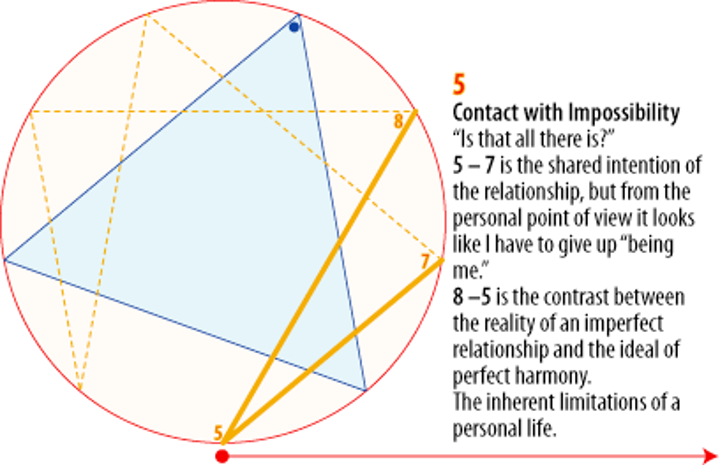
One friend of mine described this as the “Is this all there is?” stage. Anyone who is reasonably self-aware and has been in a committed relationship for several years has asked themselves “Is that all there is?” at point 5. That is not all there is, not nearly all. But point 5 is as far as we can go by ourselves, as separate personalities. In order to get around the blind corner, a leap of faith is required: a leap of faith in oneself, in one’s partner, in the unnamable mysterious something that is “bigger than both of us.” This leap of faith carries one across the unbridgeable gap between aspiration and reality. It is a leap into a new dimension of being together, one which we can call the transpersonal.
Again we find ourselves in front of a “corner,” a crossroads, a point at which new possibilities can open and others must be closed. Like point 2, point 5 is connected to point 8, the culmination or fruition of the relationship. But at point 2 we looked into the Garden. At point 5 the Gardener looks into us. We see where we are and confront the many ways our reality, our manifestation, falls short of perfection. The turning point at 2 was a pleasant place. We were in love. By committing to this relationship, we affirmed our faith in the partner we have chosen to live and love with. Our faith in ourselves was not in question. And we saw the way forward, or at least we thought we could.
Point 5 offers none of these blessings, only a very tough choice to accept the call to another kind of experience. Point 5 is a blind corner, a crossroads without signposts. To many people, it seems like a dead end because the way through, the way forward, is so dark. At point 3 we needed faith in our partner. More than anything, at point 5 we need faith in ourselves, in that innermost core of ourselves that is both individual and universal. What makes it so hard to find is that we are seeing our shadow: in the Jungian sense, the dark, hidden parts of ourselves that are so private that we usually don’t allow ourselves to experience them. It’s very hard to see that what makes the shadow stand out so clearly is the light of the free-er, true-er, larger self we are destined (but not fated) to become. It is the direct contact we had at point 2, only from the other direction: the light of love is behind us, enabling us to see all too clearly where we fall short of perfection. At point 2 the light was shining in our vision, blinding us to the flaws in our reality and the difficulties of overcoming those problems. At point 5 all we can see is the flaws and problems. Yet this is possible because we are closer than ever to the realization of the vision we had at point 2.
Keep reading with a 7-day free trial
Subscribe to Turning Into Each Other to keep reading this post and get 7 days of free access to the full post archives.